

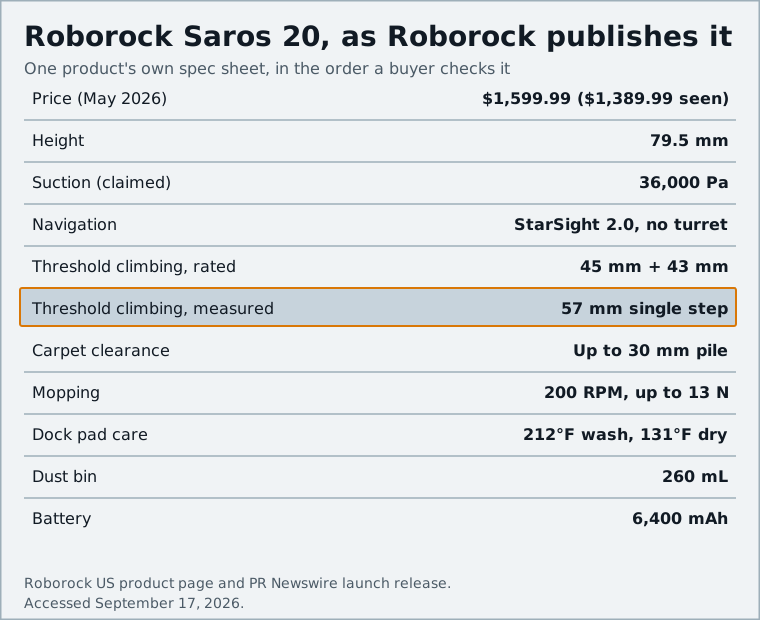
The Roborock Saros 20 is the company's new flagship, and it arrives with one party trick nobody else matches: it climbs. Roborock rates it for a 45 mm step in one go and 88 mm over two, which puts most door thresholds, rug edges and sunken living rooms within reach of a robot that is also only 79.5 mm tall. It vacuums and mops at the top of the class. It also costs $1,599.99, has a small dust bin, and ships with a dock the size of a bedside table. This review pulls together our reading of the measured results, the launch claims and the competition to answer the only question that matters at this price: who actually needs it?
Verdict: The Saros 20 is the best robot for homes with raised thresholds, sunken rooms and deep rugs, and its mopping and hair handling are among the best measured. If your floors are flat, a robot at half the price cleans almost as well, and the Saros 10R does the low-profile trick for the same money with a better record on obstacles. 8/10.
Design: 79.5 mm tall, no lidar turret, and a lifting chassis
The Saros 20 looks like a Saros 10R that has been to the gym. There is no spinning lidar turret on top; navigation comes from what Roborock calls the StarSight Autonomous System 2.0, a combination of solid-state 3D time-of-flight sensors and an RGB camera. That keeps the body at 79.5 mm (3.13 in), low enough for most sofas and beds.
Underneath is the AdaptiLift Chassis 3.0: the drive wheels and the front caster can lift the body independently, and a climbing arm at the rear pushes the robot up and over obstacles. Roborock's product page rates it for a "double-layer" climb of 3.46 inches, which the launch press release breaks down as 4.5 cm plus 4.3 cm across two steps.
Other design points from the spec sheet:
- FlexiArm side brush and mop that swing out to reach corners and edges down to 2 cm clearance
- DuoDivide anti-tangle main brush split in two halves so hair feeds toward the center
- VertiBeam side sensors for lateral obstacle avoidance along walls and furniture legs
- Dual spinning mop pads that lift for carpet, with adaptive downforce
Threshold climbing and carpet: does AdaptiLift 3.0 really work?
Yes, and by a wider margin than the marketing suggests. Vacuum Wars measured a 57 mm single-step threshold, a record in its testing, against Roborock's own single-tier claim of 45 mm. The two-tier climb worked to the rated 88 mm total. In practice that means a typical wooden door saddle, a thick rug border or a one-inch sill between a tiled kitchen and a wooden hallway no longer needs a ramp.
The lift also helps on carpet. The chassis raises the body to keep up to 30 mm pile from bogging down the brush, and the wet pads lift clear of the fibers when the robot is mopping. Not every crossing is effortless: TechRadar found the robot hesitant at first, and only after a few attempts did it learn to clear a chunky hall-to-living-room threshold by backing up, lifting its nose and approaching at speed, while Notebookcheck needed two steps to get over a 4.5 cm ledge. Treat the maximum figure as a best case rather than a guarantee, and expect it to depend on the approach angle and the surface on either side of the step.
Vacuuming results: carpet, hard floor and pet hair
Roborock's headline number is 36,000 Pa of suction, which is a lab figure with a closed inlet and not a useful predictor of cleaning. The measurements that matter come from standardized debris tests, and here the Saros 20 does well:
Scroll sideways to see the full table →
| Test (Vacuum Wars) | Saros 20 | Category average |
|---|---|---|
| Embedded sand on carpet | 89% | 78% |
| Flattened pet hair pickup | 88% | 82% |
| Hair wrap on brush | 0% | 26% |
| Airflow | 15 CFM | 17 CFM |
| Coverage per charge | ~1,038 sq ft | ~1,170 sq ft |
The 89 percent embedded-sand figure is the one to notice: deep carpet cleaning is where most robots fall short, and this is a top-tier result. The zero-percent hair wrap comes from the split DuoDivide brush and matters far more than suction if you have long-haired people or pets. Airflow is slightly below average, which shows up in the coverage number: the robot spends more time per square foot than a typical flagship, though Notebookcheck cleaned 50 square meters in an hour and a half and came back with more than 40 percent of the 6,400 mAh battery left.
On hard floors, the combination of the swinging side brush and the low body makes edge and corner cleaning noticeably better than a turret robot's, and the vacuum is reasonably quiet: Tom's Guide measured 60 dB while vacuuming, about the level of a conversation, and 70 dB during bin emptying. It is the dock, not the robot, that makes the noise.
Mopping: 200 RPM pads, 13 N of pressure and hot-water washing
The two round pads spin at 200 RPM with up to 13 newtons of adaptive downforce, and the robot can extend the right pad outward along walls. Vacuum Wars' stain-removal score of 116 against a 94 average put it among the best spinning-pad systems tested, and it did so while using slightly less water than average. TechRadar likewise found the mopping even and full-coverage, though Tom's Guide reported patches left unmopped in a whole-home run. As with every spinning-pad robot, dried-on stains on textured tile and grout lines are where it runs out of talent.
Spinning pads remain a compromise compared with the roller mops on the Ecovacs T90 Pro Omni or Eufy's C28, which drag a continuously rinsed roller across the floor. The Saros 20 closes the gap with the dock: after each session it washes the pads with water heated to 212°F, then dries them with 131°F air. That is the difference between pads that smell fine in a week and pads that do not.
Obstacle avoidance and mapping with StarSight 2.0
Roborock claims StarSight 2.0 recognizes more than 300 object types and samples the environment 21 times faster than a spinning lidar. The measured result is good, not perfect: 17 of 24 obstacles avoided against a 16 average, and a step behind the Saros 10R, which scored a perfect 24 in the same test. Tom's Guide never had to rescue it from under a coffee table or a nest of cables, while TechRadar saw it push a few items it should have avoided and, like every robot, chew on a cable or two.
Mapping is the same fast, multi-floor system as the Saros 10R, with room division, no-go zones and virtual walls set from the app. The onboard camera can also be used for remote viewing from the app, which privacy-minded buyers may count as a reason to disable it.
The RockDock: what it automates and what you still do by hand
The dock empties the bin, refills the water tank, washes the pads with hot water, dries them, and holds a disposable dust bag that Roborock rates for up to 65 days between changes. A detergent cartridge doses cleaning solution automatically.
What you still do: fill the clean-water tank and empty the dirty one every few sessions, wipe the wash tray occasionally, and swap the bag. The dock's main drawback is physical: it is a tall unit with two water tanks that you will not want to carry between floors. If you have a multi-story home, plan on the robot staying on one level, or on a second dock.
Battery, noise and the small dust bin
The 6,400 mAh battery is large; the sub-average coverage figure is down to the robot's careful pace rather than a weak cell, and it recharges and resumes without fuss. Noise is a strength while cleaning (60 dB in Tom's Guide's measurement) and a weakness at the dock, where bin emptying hit 70 dB in the same test and TechRadar notes an audible hum while the pads dry. Schedule the dock cycle for a time you are not on a call.
The weakest spec is the onboard bin: 260 mL against a 377 mL average. The auto-empty dock mostly hides this, but on a large, dirty floor the robot may return mid-run to empty, which adds time.
App, modes and Matter support
The Roborock app is powerful and, as TechRadar puts it, offers oodles of control options that can be a little overwhelming for newcomers. There are several named cleaning modes on top of the usual suction and water levels, and per-room, per-surface settings for each. Set up one routine you like and ignore the rest.
The Saros 20 is Matter compatible, which means it can be added to Apple Home (via Siri Shortcuts), Google Home, Alexa or Home Assistant for start, stop, dock and room-cleaning commands without a cloud skill. Matter exposes only basic controls; mode selection and maps stay in the Roborock app.
Specifications
Pros
- Record-setting threshold climbing plus a 79.5 mm body
- Excellent embedded-carpet and pet-hair results with zero hair wrap
- Best-in-class spinning-pad mopping with boiling-water pad washing
- Quiet while cleaning; large battery
- Matter support
Cons
- $1,599.99 is a lot when a $500 robot cleans flat floors almost as well
- Obstacle avoidance trails the Saros 10R
- Small 260 mL bin and below-average airflow
- Tall dock; app can overwhelm newcomers
Who should buy it, and the cheaper alternatives
Buy it if your home has thresholds, split levels or thick rugs that have defeated previous robots, or if long hair has wrapped every brush you have owned. The climbing chassis and the DuoDivide brush solve problems that no discount fixes.
Skip it if your floors are flat and mostly hard. Prices below are US list prices as of May 2026 and all are discounted regularly:
- Roborock Saros 10R ($1,599.99 list). Same low profile, a perfect obstacle-avoidance score in Vacuum Wars' testing, and a fixture near the top of RTINGS' robot vacuum rankings. It does not climb. If you have obstacles on the floor rather than in it, this is the better Roborock.
- Ecovacs Deebot T90 Pro Omni ($799.99). 30,000 Pa, a 27 cm roller mop with heated washing, and a dock that refills and empties. Half the price for most of the mopping ability.
- Eufy Omni C28 ($799.99 list, regularly $599.99 or less on sale). Roller mop and a refill-and-empty dock at a fraction of the price; Tom's Guide rated it well above what its price suggests. It has none of the Saros 20's climbing tricks.
- iRobot Roomba Max 705 Combo ($1,299.99 list, often heavily discounted). Lidar navigation and a good roller mop, but carpet results lag. iRobot itself filed a prepackaged Chapter 11 in December 2025 and emerged in January 2026 owned by its contract manufacturer, Shenzhen Picea Robotics. The company says apps and warranties continue, but it is a factor in a $1,300 purchase.
If you are weighing a robot against fixing the network it lives on, our guide to smart home devices that keep dropping off Wi-Fi is worth a read first; a robot that loses its dock connection is a robot that stops mid-room.
The Roborock Saros 20 earns its flagship badge on measured cleaning, mopping and hair handling, and it is the only robot we would send at a raised threshold with confidence. Whether it earns $1,599.99 depends entirely on your floors: uneven, rug-heavy or hair-covered homes get something no cheaper robot offers, while flat, hard-floored homes should buy the Saros 10R for obstacles or spend half as much on a Deebot T90 Pro Omni or Eufy C28.
Sources and further reading
- Roborock Saros 20 review (Vacuum Wars)vacuumwars.com
- I tested the Roborock Saros 20 and it's a must-have for pet owners (Tom's Guide)tomsguide.com
- Roborock Saros 20 review: another outstanding flagship (TechRadar)techradar.com
- No door threshold can stop this flagship robot vacuum: Roborock Saros 20 review (Notebookcheck)notebookcheck.net
- Roborock Launches Saros 20 in North America (PR Newswire)prnewswire.com
- Roborock Saros 20 product page (Roborock US)us.roborock.com
- The 4 Best Robot Vacuums of 2026 (RTINGS)rtings.com
- eufy Robot Vacuum Omni C28 (eufy US)eufy.com
- I tested the Eufy Omni C28 (Tom's Guide)tomsguide.com
- Deebot T90 Pro Omni (Ecovacs US)ecovacs.com
- iRobot Announces Strategic Transaction to Drive Long-Term Growth Plan (iRobot)media.irobot.com
- iRobot to enter Chapter 11 and be acquired by Chinese creditor (The Robot Report)therobotreport.com