

On 18 February 2027 the most consequential phone rule since the USB-C mandate takes effect in the European Union: every new phone and tablet must either let you remove and replace its battery yourself, or ship with a battery tough enough to survive 1,000 charge cycles. This deep-dive explains what the law actually says, where the loopholes are, how Apple, Samsung and the Chinese brands are likely to respond, and what it means for you whether you live in Europe or not. Our thesis: the rule will not bring back the pop-off battery covers of 2010, but it will quietly make every phone last longer, and that is the better outcome.
What the rule requires, and the escape hatch for phones
- Article 11 of the EU Batteries Regulation requires portable batteries in products to be "readily removable and replaceable by the end-user" from 18 February 2027.
- Phones and tablets get an escape hatch: a battery that keeps 83% capacity after 500 cycles or 80% after 1,000 cycles, in a device rated IP67 or better, only has to be replaceable by a professional.
- A separate ecodesign rule, in force since 20 June 2025, already requires 800-cycle batteries, seven years of spare parts, five years of OS updates and a repairability score on the energy label.
- Expect thin, sealed flagships to take the durability route and cheaper or rugged phones to take the removable route.
- The rule applies to what is sold in the EU, but phone makers rarely build region-specific hardware, so most of the benefit will travel.
The rule in one paragraph
Regulation (EU) 2023/1542 replaced the old Batteries Directive and covers everything from AA cells to EV packs. Its Article 11 says that any product containing a portable battery must be designed so the battery can be removed and replaced by the end user, using commercially available tools, at any point during the product's life. A manufacturer that needs a special tool has to supply it free of charge, and it cannot require heat, solvents or a trip to a service center. The regulation also requires replacement batteries to stay available as spare parts for at least five years after the last unit of a model is placed on the EU market.
Timeline: June 2025 durability rules, February 2027 battery rules
Two separate pieces of law overlap here, and most of the confusion online comes from mixing them up.
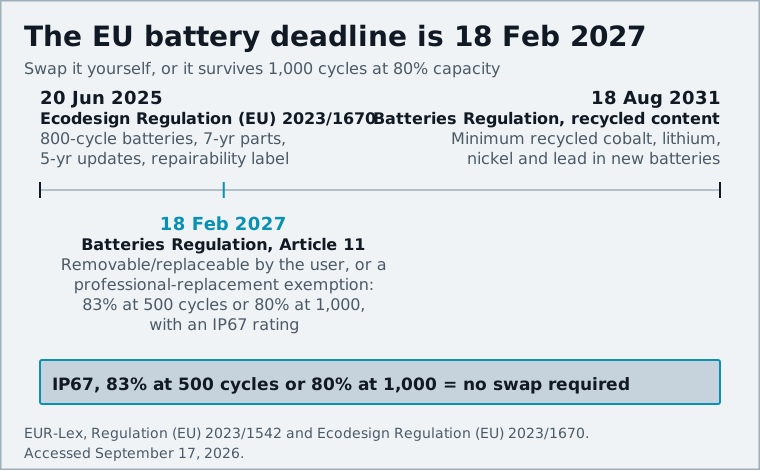
The ecodesign rule in force since 20 June 2025 also requires phones to resist drops, scratches and water. A third date does not move as much as the first two: from 18 August 2031, new batteries must also contain minimum shares of recycled cobalt, lithium, nickel and lead.
The ecodesign rule is the one you can already see in shops. Since June 2025 every new phone sold in the EU carries a label that grades energy efficiency, battery endurance, repairability and ingress protection, and it bans software tricks such as parts pairing that block independent repair. The 2027 rule is the one that decides whether you personally get to open the phone.
What "user-replaceable" actually requires
The Commission published guidelines in early 2025 to spell out what "readily removable" means in practice, and Cooley's analysis of that guidance is the clearest reading of it. The short version:
- Tools. The battery must come out with commercially available tools. That is a broader category than the "basic tools" repair advocates wanted; a Torx driver you can buy online counts. Proprietary bits do not.
- No destructive steps. If removal requires heating the back glass, dissolving adhesive with solvent, or damaging the housing, the design fails.
- Instructions. The manufacturer must publish clear removal and replacement instructions.
- No software locks. A replaced battery cannot be crippled by the phone refusing to recognize it, which is the parts-pairing ban again.
Right to Repair Europe argues the guidelines were watered down. The group criticized the shift from "basic" to "commercially available" tools and pointed out that the text never defines what a "reasonable and non-discriminatory price" for a spare battery is. Those are fair complaints, but the core requirement still stands: pry tool and screwdriver, yes; heat gun and glue, no.
The 1,000-cycle, 80% capacity durability bar
Here is the part that matters for flagship phones. Where a product is covered by both the Batteries Regulation and the smartphone ecodesign rule, the ecodesign rule takes precedence. That creates a specific exemption: a phone whose battery retains at least 83% of its capacity after 500 full cycles, or at least 80% after 1,000 cycles, and which is rated IP67 or better against water, only needs a battery that a professional can replace.
The numbers are not arbitrary. Most phone batteries a few years ago were rated for roughly 500 cycles to the 80% mark, and the ecodesign baseline that everyone must meet is 800. Google already advertises about 1,000 cycles to 80% for the Pixel 8a and later, and Apple's own battery documentation says iPhone 15 and later are designed to retain 80% at 1,000 cycles, up from 500 on earlier models. In other words, the two biggest premium brands already clear the bar, which is why the analysts quoted by The Economy expect both to lean on the exemption rather than redesign their phones. Your next iPhone will almost certainly not have a pop-out battery.
Repair advocates see this as a missed opportunity, and they have a point: durability and repairability are not opposites. But from a consumer's perspective, a battery that genuinely lasts 1,000 cycles is roughly three years of daily charging before it is worn, which is the point at which many people replace the phone anyway.
QR codes, labels and the battery passport
The Batteries Regulation also changes what is printed on the cell. From February 2027 every battery, including the one in your phone, must carry a QR code linking to information about its components, chemistry and recycled content, alongside the familiar crossed-out bin symbol.
One clarification, because it is widely misreported: the full "digital battery passport," with carbon footprint and state-of-health data, is mandated for EV, e-bike and large industrial batteries, not for phone batteries. Your phone's battery gets the QR code and the labeling rules; it does not get the passport. That said, both iOS and Android now show cycle counts and capacity in software, so the state-of-health information exists anyway. Our guide to protecting phone battery health on iOS 26 and Android 16 shows where to find it.
How manufacturers may respond: removable designs vs tougher cells
There are two ways to comply, and the industry is already splitting along price lines.
The durability route. Analysts quoted by The Economy in April 2026 expect Apple and Samsung to rely on the 1,000-cycle exemption rather than redesign their sealed flagships, and to market long-life cells as a premium feature. Samsung has also been fitting pull-tab adhesive strips to recent Galaxy batteries so a technician can lift the cell without solvent, which helps with the professional-replacement requirement without changing the exterior.
The removable route. Rugged and budget phones are the obvious candidates. GSMArena pointed to the Galaxy XCover6 Pro, which pairs a user-removable battery with IP68 and MIL-STD-810H ratings, as proof that a swappable cell and serious water resistance are not mutually exclusive. Fairphone has shipped exactly this design for years. For a manufacturer that cannot hit 1,000 cycles cheaply, a screw-down back cover is the easier engineering problem.
The awkward middle. Foldables carry two batteries linked by ribbon cables, and neither route is simple for them. And many Android brands are moving to silicon-carbon cells for their higher energy density, but 9to5Google reports those cells tend to lose more capacity in their first two to three years than conventional lithium-ion, because the silicon anode swells with every charge. A brand that wants both a 6,000 mAh silicon-carbon battery and the durability exemption may have to cap usable capacity in software, as Nothing already does. Our silicon-carbon battery explainer covers the chemistry.
Will phones get thicker, less waterproof or more expensive?
Thicker: Only if the maker chooses the removable route, and even then modestly. The XCover6 Pro, with its removable 4,050 mAh cell, is 9.9 mm thick. Flagships on the durability route will not change shape at all.
Less waterproof: The exemption explicitly requires IP67 or better, so the phones most likely to keep sealed designs are the ones that are already waterproof. Removable-battery phones need gaskets instead of glue, which is a solved problem in rugged devices.
More expensive: This is the genuine risk. The Economy's sources expect long-life cells to be repositioned as premium features reflected in higher prices. Against that, a battery that lasts three years instead of two is money you do not spend on a replacement or a new phone, and the ecodesign rule's seven-year parts guarantee means the replacement will exist when you need it. On balance we expect a small up-front cost and a larger lifetime saving.
What this means for buyers outside the EU
The rules bind products placed on the EU market, not products sold elsewhere. But phone makers design one chassis for the world; the USB-C mandate ended Lightning everywhere, not just in Europe. Expect the same here: 1,000-cycle batteries, pull-tab adhesives and published repair instructions will show up globally because maintaining two designs costs more than complying once.
What may not travel is the spare-parts pricing and the repair-information obligations, which are enforced by EU market surveillance authorities. If you are outside the EU, the practical benefit is better hardware; the practical gap is that nobody is forcing your local market to sell you the battery at a reasonable price.
Counter-arguments worth taking seriously
Three objections deserve a straight answer.
"The exemption guts the rule." Partly true. If you wanted a phone you can open with a fingernail, this law will not deliver it for flagships. But the alternative outcome, in which the rule forces a 1,000-cycle cell into every phone, is arguably better for most people, who never replace a battery but do notice when one wears out in 18 months.
"Commercially available tools is too vague." Right to Repair Europe is right that this is weaker than "basic tools." Enforcement will hinge on whether authorities accept a design that needs six screws and a spudger. Our reading of the Commission's guidance is that they will, and that this is still a vast improvement over glue.
"It will slow innovation in battery chemistry." The opposite seems more likely. The 1,000-cycle bar is precisely the kind of target that pushes brands to solve silicon-carbon degradation rather than paper over it.
None of those objections changes where the rule lands. From 18 February 2027, a phone sold in the EU must either open up for a battery swap or carry a battery good for 1,000 cycles at 80% capacity. Flagships will take the durability route, budget and rugged phones will take the removable route, and both outcomes leave you with a phone that lasts longer than the one you have now. That is not the pop-off cover some people hoped for, but it is the best consumer-tech rule since USB-C.
Sources and further reading
- Regulation (EU) 2023/1542 concerning batteries and waste batteries - EUR-Lexeur-lex.europa.eu
- Sustainability rules for batteries and waste batteries (summary) - EUR-Lexeur-lex.europa.eu
- EU Ecodesign for smartphones including right to repair now in effect - Hackadayhackaday.com
- Making batteries removable and replaceable: a closer look at the new EU guidelines - Right to Repair Europerepair.eu
- European Commission publishes guidance on removability requirements - Cooley Productwiseproducts.cooley.com
- EU to mandate user-replaceable smartphone batteries - The Economyeconomy.ac
- New EU legislation can bring back user-replaceable batteries - GSMArenam.gsmarena.com
- iPhone battery and performance - Apple Supportsupport.apple.com
- The silicon-carbon battery problem - 9to5Google9to5google.com