

The Ryzen 7 9850X3D is the fastest gaming CPU you can buy as of its January 29, 2026 launch, and it is also one of the least necessary upgrades AMD has ever shipped. It takes the Ryzen 7 9800X3D, the chip that has topped gaming charts since late 2024, and adds 400MHz of boost clock for $20-30 more. This review pulls together what independent labs at Tom's Hardware, GamersNexus and Club386 measured so you can decide whether the extra clock is worth paying for, or whether the discounted 9800X3D is the smarter buy.
Verdict: The 9850X3D is the world's fastest gaming processor by a margin of roughly 3-4% over the 9800X3D, often less, at a cost of about 20W more package power and higher temperatures. Buy it if you are building a new high-end AM5 rig and the price gap to a 9800X3D is $30 or less. Anyone who already owns a 9800X3D, or who can find one on discount, should keep their money.
Pros
- Fastest gaming CPU available, if only by a technicality
- 96MB of L3 cache makes it unusually tolerant of slow, cheap DDR5
- Same AM5 socket, 120W TDP class and cooler compatibility as the 9800X3D
- 15-24% faster than the still-popular 7800X3D
Cons
- At best 4% faster than the 9800X3D in games; sometimes identical
- Draws around 20W more and runs 7-9°C hotter under all-core load
- $499 MSRP is higher than street pricing on the 9800X3D
- Low-single-digit productivity gains do nothing to justify the premium for non-gamers
What the 9850X3D is: a 9800X3D with more clock
AMD announced the 9850X3D at CES 2026 as its "new fastest gaming processor," promising up to a 7% uplift over the 9800X3D. Tom's Hardware's headline for that announcement, "AMD fights itself," captured the situation: the only chip the 9850X3D needs to beat is another AMD chip that is still on sale.
Under the heatspreader it is the same design. One eight-core Zen 5 CCD sits on top of a 64MB slab of second-generation 3D V-Cache, an arrangement AMD introduced with the 9800X3D that puts the cache below the cores rather than above them. That layout lets the cores run at full clocks and be cooled directly, which is why the 9800X3D was the first X3D chip AMD allowed you to overclock. The 9850X3D pushes the boost clock from 5.2GHz to 5.6GHz and leaves everything else alone.
Reviewers noticed the family resemblance. Tom's Hardware's conclusion page is titled "A Ryzen 7 9800X3D in a trench coat", and Club386 described it as "paint on a lily."
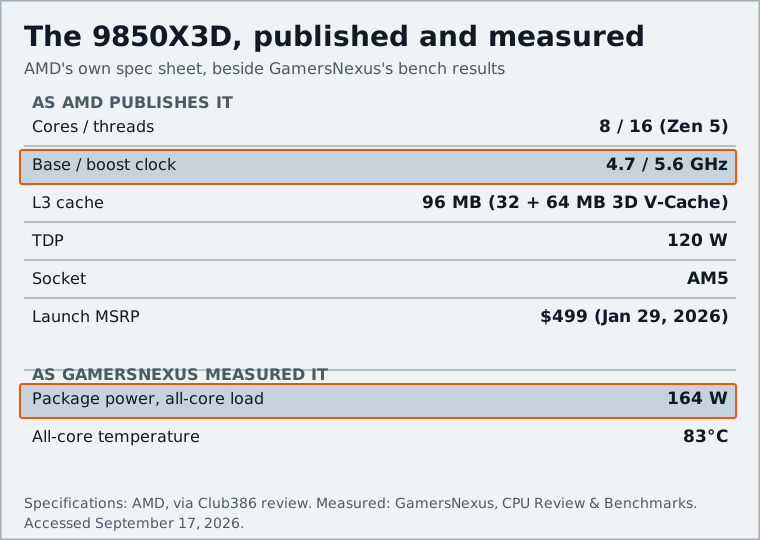
Specs, price and platform (AM5, 96MB 3D V-Cache)
Scroll sideways to see the full table →
| Specification | Ryzen 7 9850X3D | Ryzen 7 9800X3D |
|---|---|---|
| Cores / threads | 8 / 16 (Zen 5) | 8 / 16 (Zen 5) |
| Base / boost clock | 4.7GHz / 5.6GHz | 4.7GHz / 5.2GHz |
| L3 cache | 96MB (32MB + 64MB 3D V-Cache) | 96MB (32MB + 64MB 3D V-Cache) |
| TDP | 120W | 120W |
| Socket | AM5 | AM5 |
| Launch MSRP | $499 (January 29, 2026) | $479 (November 2024) |
| Street price at 9850X3D launch | $499 | About $469-479, with dips to $399 |
Specs and pricing come from Club386's review and Tom's Hardware's pre-launch pricing report, which noted retailers were listing the chip before its official launch date. Prices are as of late January 2026.
The platform story is the good news. Any AM5 board with a current BIOS takes the 9850X3D, so an owner of a Ryzen 5 7600 or Ryzen 7 7700 can drop it in without touching memory, cooler or motherboard. AMD has committed to supporting AM5 through at least 2027, which matters when Intel has already moved to a new socket since AM5 arrived.
Gaming performance: a few percent faster, sometimes identical
Three independent test suites arrived at the same answer from different directions.
Tom's Hardware crowned it the world's fastest gaming processor but said it "wins by a technicality" where AMD used to own the title "with overwhelming force," and it measured around 30% higher power consumption in games than the 9800X3D for that small lead.
GamersNexus put the average uplift at about 3.3% and the gap at "at best 4% faster", noting the two chips were "sometimes identical." Against the older 7800X3D, however, the 9850X3D was 15-24% faster depending on the game, which is a meaningful jump for anyone still on Zen 4.
Club386's game-by-game numbers show how thin the lead really is:
Scroll sideways to see the full table →
| Game (1080p) | 9850X3D | Gain over 9800X3D |
|---|---|---|
| Final Fantasy XIV: Dawntrail | 323 fps | +10 fps (+3%) |
| Forza Motorsport | 182 fps | +5 fps (+3%) |
| Cyberpunk 2077 | 100 fps | Within a frame or two |
| Rainbow Six Siege X | 513 fps | +2 fps |
| Total War: Warhammer III | 146 fps | +1 fps |
Every one of those results is inside the run-to-run variance you would see from a driver update. At 1440p and 4K, where the GPU becomes the limit, the two chips are indistinguishable. If you play at high resolution on anything short of a flagship GPU, you will not be able to tell which X3D chip is in the box.
The comparison that matters more for shoppers is with Intel. The Core Ultra 9 285K remains well behind both X3D chips in gaming, and Intel has no cache-stacked answer on the desktop. In practical terms, the 9850X3D's real competitor is the 9800X3D at whatever discount it is selling for this week.
Productivity, power draw and temperatures
Adding 400MHz of boost does more for productivity than for gaming, but not by much. Independent reviews put the multi-core gains over the 9800X3D in the low single digits. If you render, compile or encode for a living, the Ryzen 9 9950X3D's 16 cores remain the better tool; the 9850X3D is a gaming chip that happens to be adequate at everything else.
The clock increase does show up on the power meter. GamersNexus recorded 164W of package power under all-core load versus 143W for the 9800X3D, with load voltage rising from 1.18V to 1.231V. All-core temperatures climbed to about 83°C from the 74-75°C of the older chip on the same cooler. Club386 saw a smaller whole-system delta of around 9W, which suggests the gap depends on the workload and the board's power limits.
None of that is alarming. A 240mm AIO or a good dual-tower air cooler handles the 9850X3D comfortably, and the same cooler you would buy for a 9800X3D is fine. It does mean the 9850X3D is slightly less efficient per frame than its predecessor, which is an odd thing to say about a chip that is supposed to be an improvement.
Memory: why X3D shrugs off slow DDR5 in a RAM-price crisis
The most useful finding in any 9850X3D review has nothing to do with the CPU's own clocks. GamersNexus ran its entire test suite with a DDR5-4800 kit, the slowest JEDEC speed, as a deliberate reflection of 2026 memory prices, and found the slow kit cost the 9850X3D only a couple of percent in games: 2% in Final Fantasy XIV and under 1% in Cyberpunk 2077. Chips with a conventional 32MB L3 lose far more with the same downgrade because they are constantly fetching data from RAM; the X3D's 96MB keeps most of what a game needs on the package.
That changes the calculus of an AM5 build in 2026. With memory makers telling CNBC in January that AI demand had sold out their 2026 output and contract prices set to jump by as much as 55% in a single quarter, the money you would once have spent on a fast, low-latency kit is better spent on the CPU. Pair an X3D chip with the cheapest 32GB DDR5 kit you can find, accept the single-digit loss, and you will still be ahead of a non-X3D CPU with expensive memory. Our guide to the 2026 DDR5 price crisis has the full memory-buying strategy.
The DDR5-6000 CL30 kits that used to be the default recommendation are still the sweet spot for AM5 when they are affordable. They just stopped being mandatory.
Verdict: who should buy it, and who should buy the 9800X3D instead
Buy the 9850X3D if:
- You are building a new high-end gaming PC and the 9850X3D is within $30 of the 9800X3D at the time you buy. For a rounding-error premium you get the newest chip and the marginally higher ceiling.
- You are upgrading from a Ryzen 5000 or 7000 non-X3D part, or from a 7800X3D and want the biggest jump AM5 offers in eight cores. The 15-24% gain over the 7800X3D is real.
- You play competitive esports titles at 1080p on a flagship GPU, the one scenario where a few percent of CPU headroom shows up on screen.
Buy the 9800X3D instead if:
- The 9800X3D is on sale. At the $399-469 street prices seen around the 9850X3D's launch, the older chip delivers 96-100% of the performance for 80-90% of the money. Club386's conclusion that the 9800X3D remains the better-value sibling is hard to argue with.
- You play at 1440p or 4K, where the two chips are identical.
- You want the cooler, lower-voltage version of the same silicon.
Skip both if:
- You already own a 9800X3D. There is no upgrade here, and GamersNexus's advice that this is "not something you should spend a lot on" applies doubly to a sidegrade.
- Your work is multi-threaded rendering or compilation; a 9950X or 9950X3D is the better buy for the same money or slightly more.
Sources and further reading
- AMD Ryzen 7 9850X3D review: The world's fastest gaming processor, again (Tom's Hardware)tomshardware.com
- AMD's next gaming champ to debut at $499 (Tom's Hardware)tomshardware.com
- AMD's Ryzen 7 9850X3D promises 7% uplift over Ryzen 7 9800X3D (Tom's Hardware)tomshardware.com
- AMD Ryzen 7 9850X3D review: the fastest gaming CPU, but not by much (Club386)club386.com
- AMD Ryzen 7 9850X3D CPU Review & Benchmarks ft. DDR5-4800 (GamersNexus)gamersnexus.net
- AMD Ryzen 7 9850X3D CPU Review: Fastest 8-Core (The FPS Review)thefpsreview.com
- AI memory is sold out, causing an unprecedented surge in prices (CNBC)cnbc.com