

On June 2, 2026 the FBI issued a fresh warning about scams that use AI to clone the voice of a child, grandchild or spouse and then stage a fake emergency to extract money. The calls are convincing, the pressure is intense, and the payment methods are chosen to be irreversible. This article explains what the FBI said, how the scam is actually built, which red flags give it away, and a family plan you can put in place tonight that no voice model can beat.
What the FBI warned about this week
The bureau's June 2 alert, reported by KPRC in Houston, describes criminals mimicking a family member's voice to claim they have been arrested, injured or kidnapped, then demanding money before the victim has time to think. The FBI put the cost of AI-related scams at more than $893 million in the previous year.
The same week, Consumer Reports flagged the trend, citing the case of Deborah Del Mastro, who received a call in which what sounded like her daughter pleaded for help while a man demanded $20,000. She wired $5,000 before discovering her daughter was safe.
Separately, the FBI has been warning since a December 2025 public service announcement about "virtual kidnappings" that pair a cloned voice with doctored photos or videos as fake proof of life. Local outlets, including KIRO 7 in Seattle, have relayed that warning as families in their areas were targeted.
How a voice clone is built from a few seconds of your social media
Modern voice models do not need hours of studio recordings. Starling Bank, which surveyed just over 3,000 UK adults for its Safe Phrases campaign, states that fraudsters can replicate a voice from "as little as three seconds of audio." That is a single Instagram story, a TikTok, a voicemail greeting or a clip from a school concert someone else uploaded.
The workflow is mundane. A scammer finds a public video, extracts the audio, uploads it to one of many consumer voice-cloning tools, and types the script. The model outputs speech in the target's voice with whatever emotion is requested, including crying or panic. Combined with information scraped from the same social profiles (names of relatives, the college they attend, the city they are traveling to), the call can reference real details that make it feel authentic.
The FBI's proof-of-life PSA notes that the same public photos are edited to show a person bound or injured. Those edits often contain giveaways such as missing tattoos or scars and wrong body proportions, but scammers send them via disappearing-message features precisely so you cannot study them.
Anatomy of the call: the "virtual kidnapping" and "grandparent" scripts
Two scripts account for most of these calls.
The grandparent script. The phone rings, and a voice says "Grandma, it's me, I'm in trouble." The story is a car accident, an arrest abroad or a hospital bill. A second voice, posing as a lawyer, police officer or bail agent, takes over and explains how to pay. There is usually a plea for secrecy: "Please don't tell Mom."
The virtual-kidnapping script. A caller claims to be holding your child or partner, plays a few seconds of the cloned voice screaming or begging, and demands ransom immediately, often via wire transfer or cryptocurrency. The FBI's PSA describes threats of violence and a strict rule of keeping you on the line so you cannot call the supposed victim.
Both scripts share one design goal: keep you inside the call, emotionally flooded, until the money moves.
Red flags to listen for
The FBI's alert lists several tells. Combined with the FTC's family emergency scam guidance, these are the signals to catch:
- Unusual pauses, flat delivery or odd fluctuations in the voice, especially when the "loved one" is asked an unexpected question.
- Pressure to act right now, with no time to verify, and insistence that you stay on the line.
- A request to keep it secret from other family members.
- Payment by wire transfer, Venmo or other payment apps, gift cards or cryptocurrency. Legitimate police, courts and hospitals do not take gift cards.
- A caller ID that looks like your relative's number. Caller ID is trivially spoofed and proves nothing.
- The "loved one" is handed off quickly to an authority figure who does all the talking.
None of these alone is proof, but two or more together mean you should end the call.
The family code word: why it beats any AI
A cloned voice can say anything, but it can only draw on what the scammer knows. A code word that exists only in your family's memory is information the model does not have. The FBI, the FTC and Starling Bank all recommend one.
Pick it well:
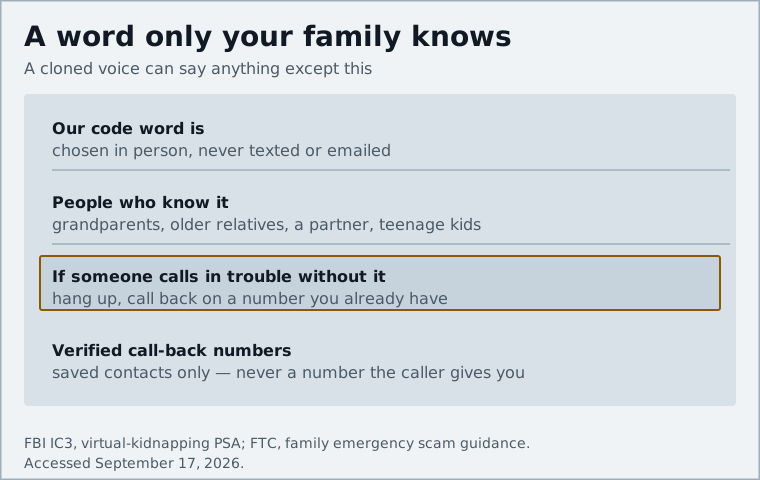
- Choose something private and slightly silly, not a pet's name, a birthday, a street or a school, all of which are probably discoverable online.
- Agree it in person or by phone, never in a group chat, email or note that could be read from a compromised account. Starling's advice is explicit: do not share it digitally.
- Tell everyone who might get a panicked call: grandparents, older relatives, a partner, teenage kids.
- Rehearse the rule: "If someone calls in trouble and cannot give the word, hang up."
That five-minute conversation is the single highest-value thing you can do after reading this article.
Hang up, call back: a verification habit that costs nothing
Even without a code word, a simple habit defeats almost every one of these calls. The FBI's June advice is to hang up and independently call the family member on a number you already have, before sending money or sharing personal details.
The scammer will argue against this. They will say the phone was taken, that calling back will get the victim hurt, that there is no time. Do it anyway. If the person does not answer, contact someone who is physically with them: a roommate, a school, a coworker, another relative. The FTC recommends exactly this second channel.
If a caller claims to be police or a hospital, look up the main switchboard number yourself and call it. Never use a number the caller gives you.
Locking down the audio and photos scammers harvest
You cannot prevent your voice from ever existing online, but you can reduce how much raw material is on offer.
- Set personal Instagram, TikTok and Facebook accounts to private, and audit who follows you.
- Replace a spoken voicemail greeting with the carrier's default robotic one.
- Ask relatives not to post videos of your children with their names attached.
- Trim "about me" details: travel plans, the school your kids attend, your parents' names.
- Review the privacy sections of our iPhone and Android security settings checklist for app permissions that quietly expose contacts and location.
Also harden the accounts themselves. A scammer who gets into an email or social account can read family chats, learn nicknames and even discover a code word if it was shared digitally. Our guide to what to do if your Google account is hacked covers recovery and lockdown.
If you already paid: what to do in the first hour
Speed matters more than anything else.
- Call the payment provider immediately. For a bank wire, ask for a recall; for Venmo, Zelle or Cash App, report the transaction as a scam; for gift cards, call the card issuer with the card numbers; for crypto, notify the exchange you used. Some transfers can be frozen if caught within hours.
- File a report with the FBI at ic3.gov. The bureau asks for phone numbers, screenshots, any audio or voicemail, and payment details.
- Report to the FTC at ReportFraud.ftc.gov. Reports feed law-enforcement databases even when your money cannot be recovered.
- Save everything. Do not delete the call log, messages or images; they are evidence.
- Warn the family. Scammers who succeed once often call back with a "second ransom" or pose as investigators offering to recover your funds for a fee.
Do not blame yourself. These scripts are engineered to bypass judgment, and the FBI's own numbers show they work on people of every age.
What the numbers say: AI-enabled fraud in the FBI's 2025 report
The FBI's 2025 Internet Crime Report, released in April 2026, is the first in the IC3's 25-year history to track AI as its own descriptor. As SecureWorld's summary lays out, that category covered 22,364 complaints and $893 million in losses, the same figure the FBI quoted in this week's warning. Total reported cybercrime losses reached about $20.8 billion across more than one million complaints, a 26% rise on 2024, according to Barracuda's analysis.
The report singles out distress scams in which "voice-cloning technology mimics the voice of a family member in apparent crisis," which SecureWorld notes accounted for more than $5 million in reported losses, and it describes voice cloning being layered into business email compromise, where a fake executive phones to confirm a fraudulent wire. Losses from tech-support and distress scams targeting people over 60 rose 59% year over year, by SecureWorld's reading of the report.
Two caveats. Most victims never report, so every number here is a floor. And many people who are scammed never realize a synthetic voice was involved, which is why the FBI itself says the real AI-related toll is likely far higher.
Voice-cloning scams work because they hit you with a loved one's voice and a ticking clock. The defenses are old-fashioned: a family code word agreed in person, a rule to hang up and call back on a known number, and a refusal to pay anyone by wire, gift card or crypto under pressure. Set the code word tonight, tell your parents and grandparents about the scripts above, and if money has already moved, call the payment provider and file with IC3 within the hour.
Sources and further reading
- FBI warns of AI voice-cloning scam that mimics loved ones in distress (KPRC Click2Houston)click2houston.com
- FBI warns of AI-driven virtual kidnappings (KIRO 7)kiro7.com
- Consumer Reports: AI voice cloning scams on the rise (WSLS)wsls.com
- Criminals Using Altered Proof-of-Life Media to Extort Victims in Virtual Kidnapping for Ransom Scams (FBI IC3 PSA)ic3.gov
- 2025 IC3 Annual Report (FBI IC3, PDF)ic3.gov
- FBI: AI-Enabled Fraud Topped $893M in 2025 (SecureWorld)secureworld.io
- Why Cybercrime Losses Hit $21 Billion in 2025 - FBI IC3 Report (Barracuda)blog.barracuda.com
- Scammers use fake emergencies to steal your money (FTC Consumer Advice)consumer.ftc.gov
- Starling Bank launches Safe Phrases campaign (Starling Bank)starlingbank.com